


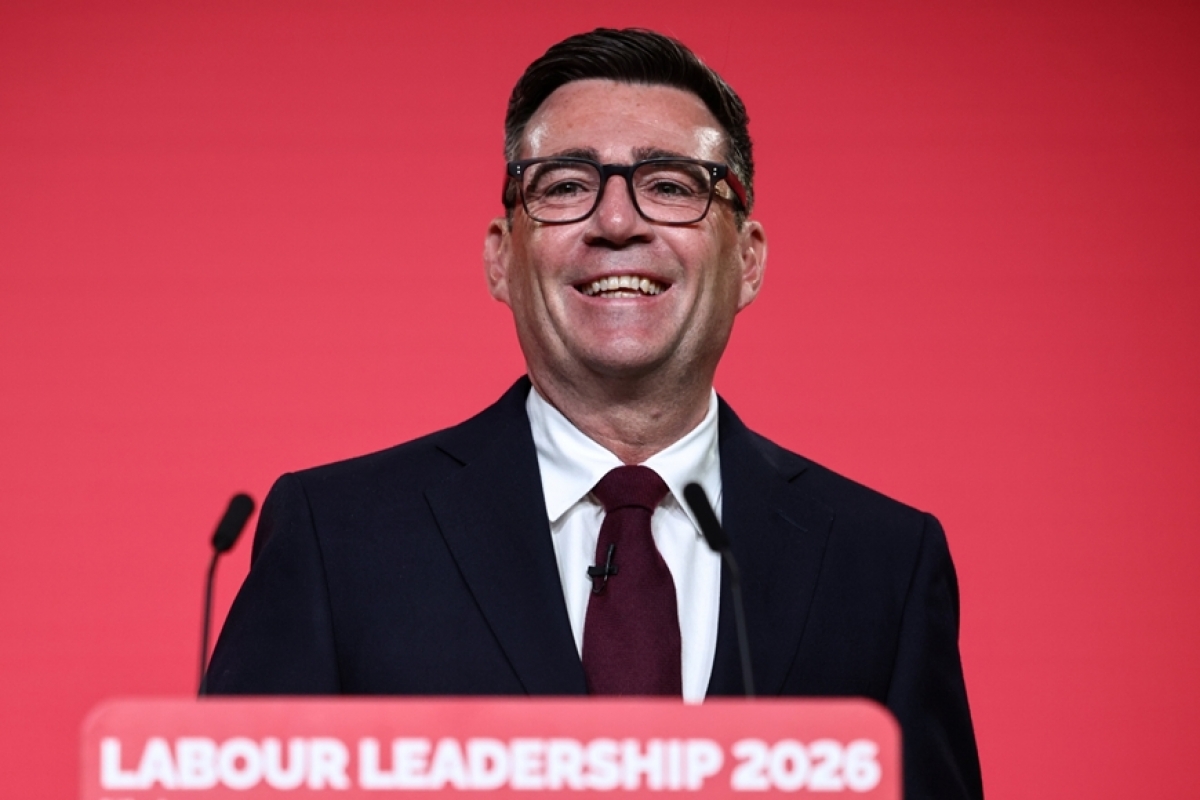
Andy Burnham has officially been confirmed as Leader of the Labour Party, completing an extraordinary political comeback that will see him enter Downing Street as the United Kingdom’s next Prime Minister on Monday.
The former Greater Manchester Mayor was formally elected at Labour’s Special Conference in London after securing the backing of 379 Labour MPs and 23 affiliated organisations, giving him an overwhelming mandate to lead both the party and the government following Sir Keir Starmer’s resignation.
The announcement was met with sustained applause inside the conference hall, where delegates rose to their feet as Burnham took to the stage for the first time as Labour leader. Beginning his address with a smile, he told supporters:
“Thank you so much friends. What a moment.”
Reflecting on the scale of the support behind his leadership, he continued:
“And what backing you’ve given me.”
Burnham paid tribute to Labour’s MPs, trade unions and socialist societies for uniting behind his candidacy, arguing that they had responded to “the call from the people of Makerfield” and, in his words, represented “forgotten places everywhere up and down this country.”
The 56-year-old struck an optimistic tone throughout a speech that marked a clear departure from the mood that has surrounded Labour in recent months. Declaring that Britain had reached a defining political moment, Burnham told delegates that the country needed a government prepared to “bring back hope” and insisted he was ready to lead that change.
In one of the most memorable moments of the afternoon, Burnham sought to reassure voters that his leadership would be built around a clear programme for government, telling the conference:
“I have a plan.”
He argued that Labour must once again become the natural party of working people, promising to reconnect with communities that had drifted away from mainstream politics over the last decade. Rather than attempting to imitate the rise of Reform UK, Burnham insisted Labour would succeed only by offering its own vision rooted in Labour values and practical government.
Burnham warned that Labour faced what he described as its “last chance” to reverse declining public confidence, saying the government must deliver “the change this country is crying out for.” He pledged to move power away from Westminster, describing devolution as central to his programme for government and arguing that too many communities had been left behind by decades of over-centralised decision-making.
The incoming Prime Minister also promised to assemble a Cabinet that reflected the country as a whole and to govern as “one united team”, saying Britain expected ministers to focus less on internal politics and more on improving people’s lives.
Friday’s confirmation marks the culmination of one of the most remarkable political comebacks in modern British politics. Burnham first sought the Labour leadership in 2010, finishing runner-up to Ed Miliband, before suffering a heavy defeat to Jeremy Corbyn five years later. After leaving Westminster politics, he reinvented himself as Mayor of Greater Manchester, earning widespread recognition for his campaigning on transport, homelessness and regional investment, as well as his public opposition to the government’s COVID restrictions during the pandemic. That period earned him the nickname “King of the North” and transformed him into one of Labour’s most recognisable politicians outside Westminster.
Supporters believe that experience has uniquely positioned Burnham to reconnect Labour with voters who have become increasingly disillusioned with national politics. His emphasis on decentralising power, investing in towns and cities outside London and strengthening local government has become a defining feature of his leadership platform.
Attention now turns to Monday, when Burnham is expected to travel to Buckingham Palace to be formally invited by King Charles III to form a government. He will then become Britain’s seventh Prime Minister in just over a decade before returning to Downing Street to appoint his Cabinet and deliver his first address to the nation.
The incoming Prime Minister faces significant challenges from his first day in office. Sluggish economic growth, pressure on the NHS, housing shortages, regional inequality and the growing electoral threat posed by Reform UK are expected to dominate his opening months. Burnham has indicated that his government will prioritise economic renewal, public service reform and a greater transfer of powers from Westminster to England’s regions.
As delegates left the conference, there was a palpable sense that Labour had entered a new era. After years spent on the political sidelines, Andy Burnham has returned to the highest office in British politics with a promise to “bring back hope” and a declaration that he is ready to deliver the change Britain has been waiting for. On Monday, that promise will be tested as he walks through the black door of Number 10 for the first time as Prime Minister.